How to Choose a Cat Water Fountain
Most fountain complaints come down to four things: pump noise, filter cost, the material, and how easy it is to clean. Here's what to check before you buy.
Justin Manuel Lantigua Germosen 7 min read
Wet versus dry, portion sizes, and which human foods are safe — feeding guidance built around how cats actually eat.
Most fountain complaints come down to four things: pump noise, filter cost, the material, and how easy it is to clean. Here's what to check before you buy.
Cats cannot be crash-dieted. Cutting food too fast risks fatal liver failure, so feline weight loss is slow, measured and supervised. Here's how it's done.
A cat suddenly emptying the water bowl is one of the most useful early warnings you get. Here's how much is normal, how to measure it, and what it can mean.
Cats and milk seem like a classic pairing, but most adult cats are lactose intolerant. Learn why milk upsets cats and what safe alternatives exist.
Overfeeding is one of the most common cat care mistakes. Learn how to calculate the right portion size for your cat based on weight, age, and activity level.
Wet or dry cat food: which is actually better? Compare hydration, dental effects, cost, and convenience to decide what fits your cat and your household best.
Onions, chocolate, lilies, and more: learn which human foods and household items are toxic to cats, the symptoms of poisoning, and what to do in an emergency.
The phrase gets used loosely, but it has specific consequences. Cats cannot make taurine in adequate amounts and must get it from animal tissue — a deficiency causes heart disease and blindness. They convert beta-carotene to vitamin A poorly and need preformed vitamin A from animal sources. They run a higher baseline protein requirement than dogs and will break down their own muscle to meet it if the diet falls short.
The practical upshot is that a cat cannot be fed like a small dog, and vegetarian diets for cats are a genuinely different proposition from vegetarian diets for dogs. It also explains why "complete and balanced" on a cat food label is doing more work than the same phrase on a dog food.
Cats descend from desert animals and evolved to extract most of their water from prey, which was roughly seventy percent moisture. Their thirst drive is correspondingly weak — a cat on dry food alone frequently does not drink enough to compensate, and runs mildly dehydrated as a baseline state.
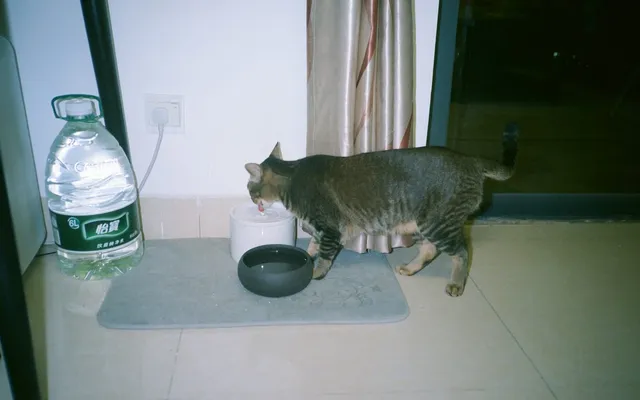
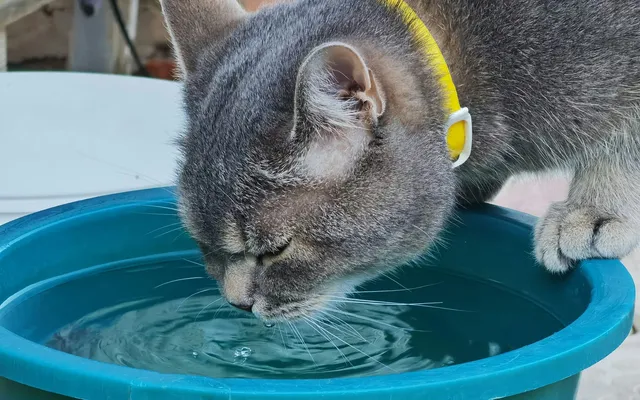
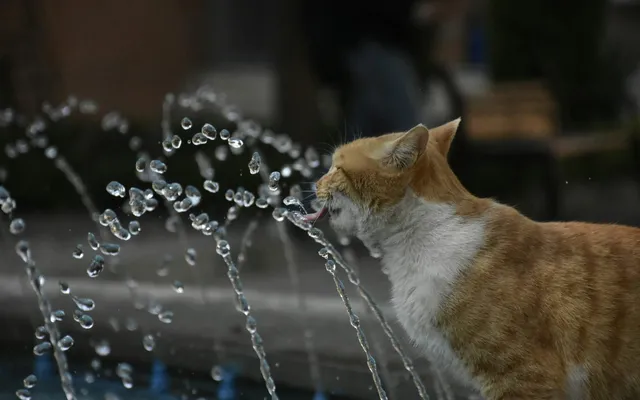
That has downstream effects on urinary and kidney health, and it is the strongest single argument for including wet food. If dry food suits your household better, the counter-measures are worth taking seriously: multiple water stations away from the food bowl, wide shallow bowls that do not touch the whiskers, and for many cats a running fountain, which they will use far more readily than standing water.
Kittens produce lactase to digest their mother's milk and mostly stop after weaning, which leaves the average adult cat lactose intolerant. The milk is not toxic, but the undigested lactose ferments in the gut and produces exactly the results that implies. The cat will usually drink it enthusiastically, which is why the myth survives — enthusiasm is not tolerance.
The full picture on dairy has some nuance, and cat-specific lactose-free milks do exist. They are still calories with little nutritional purpose, though, and a treat that displaces balanced food in a small animal costs more than it looks like it does.