
Slow Feeder Bowls and Puzzle Feeders for Dogs
One slows a dog that inhales dinner in nine seconds. The other occupies a dog that's bored. They solve different problems, and buying the wrong one wastes money.
 Justin Manuel Lantigua Germosen 8 min read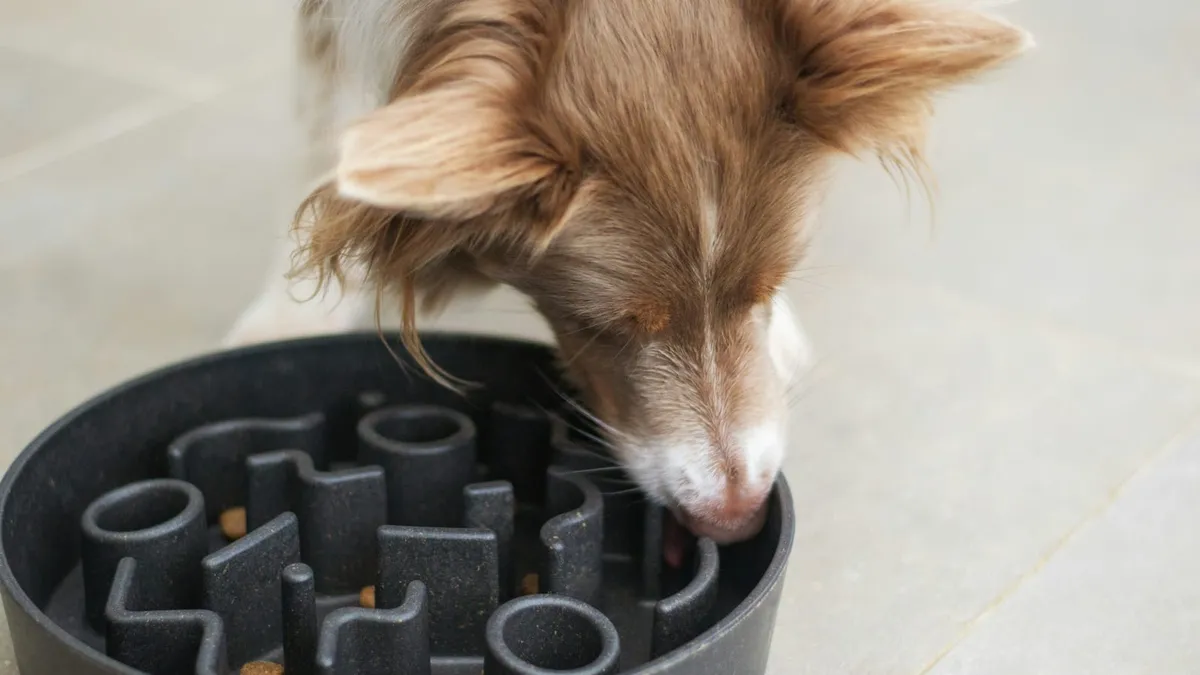
On this page
These two get sold side by side and often get confused, which is how people end up with the wrong one. A slow feeder is a bowl designed to stop a dog inhaling dinner. A puzzle feeder is a task designed to occupy a dog’s brain. Both involve food arriving more slowly, and that’s where the similarity ends.
Working out which problem you actually have takes about a minute, and it saves buying the wrong thing twice.
Key Takeaways
- Slow feeders solve speed. Puzzle feeders solve boredom. They are not interchangeable.
- Take puzzle-fed food out of the daily ration, not on top of it.
- Match the bowl design to the dog’s face: deep mazes don’t work for flat-faced breeds.
- If a dog has suddenly started bolting food or guarding the bowl, that’s a behaviour or health question first.
Which Problem Do You Have?
Your dog finishes a meal in under a minute, sometimes gags or brings food back up afterwards, and eats standing rigid over the bowl. That’s speed. A slow feeder is the right tool.
Your dog eats at a normal pace but is restless, destructive or vocal during the day, particularly when left alone. That’s occupation. A puzzle feeder helps, alongside the wider picture in our guides to how long a dog can be left alone and preparing for a change in routine.
Both. Common, particularly in food-motivated dogs like Labradors and Golden Retrievers. Buy both, use the slow feeder for meals and the puzzle for the stretch when you go out.
Slow Feeder Bowls
What They Do
A moulded pattern of ridges, mazes or pillars that the dog has to eat around. A dog who cleared a plain bowl in fifteen seconds typically takes several minutes, because they can no longer take large mouthfuls.
What the Evidence Actually Says
Slow feeders are frequently sold as bloat prevention. Being honest about this matters: gastric dilatation-volvulus is a genuine emergency, and rapid eating is one recognised risk factor among several, alongside deep-chested conformation, being fed one large meal a day, and eating from a raised bowl in some studies. The evidence that a slow feeder bowl specifically reduces bloat incidence is limited.
So: slowing a fast eater down is sensible, especially for a deep-chested breed, and it is not insurance. Our guide to dogs gulping water after exercise covers the same caution around the related risk.
What slow feeders more reliably help with is the immediate stuff: gagging, regurgitating a whole meal on the floor, and the dog who finishes in nine seconds and then stares at you.
What to Look For
Match the pattern to the face. This is the detail most people miss. Deep, narrow mazes suit a long muzzle. A French Bulldog, Pug or any brachycephalic dog physically cannot reach into a deep channel, and forcing it makes mealtimes stressful. Shallow patterns with wide channels are the ones that work.
Difficulty appropriate to the dog. Start moderate. A bowl that is genuinely impossible produces frustration, and some dogs respond by tipping it over and eating off the floor, which achieves nothing.
Non-slip base or enough weight. A light plastic bowl gets pushed round the kitchen, which is noisy and eventually defeats the design.
Cleanable, ideally dishwasher-safe. Food packs into the crevices, and a slow feeder that isn’t washed properly grows a film in exactly the grooves you can’t reach with a sponge.
Material. Stainless steel and ceramic clean up better than plastic. Plastic scratches, and scratches hold bacteria. Some dogs also react to plastic bowls around the chin and muzzle.
Size sensibly. A bowl too small for the daily portion means refilling mid-meal, which undoes the point.
Puzzle Feeders
What They Do
The dog has to work out a mechanism to release food: slide a cover, lift a flap, roll a ball, dig through fabric. It converts a thirty-second meal into fifteen to thirty minutes of concentration, and mental work tires most dogs more effectively than an extra lap of the park.
The Types
Rolling and dispensing toys. A ball or cylinder that drops kibble as it moves. Robust, easy, good for beginners, and noisy on hard floors.
Sliding and lifting puzzles. Flat boards with compartments the dog opens in sequence. More mentally demanding, usually supervised, and generally not dishwasher-safe.
Lick mats. A textured mat spread with something soft and frozen. Excellent for a dog who needs calming rather than stimulating, and the easiest entry point.
Snuffle mats. Fabric with fleece strips that food is scattered into, so the dog uses their nose. Sniffing is genuinely settling for dogs, and these suit older or less mobile dogs who can’t chase a rolling toy. Machine-washable, which matters.
Stuffable rubber toys. The classic. Stuff, freeze, and it lasts far longer than unfrozen. Best value for money in the category, and the one to reach for as you leave the house.
What to Look For
Adjustable difficulty, or start easy. Dogs give up on puzzles they can’t solve, and a dog who has given up once is harder to interest a second time.
Washability. Anything holding wet food or peanut butter needs proper cleaning, and a puzzle that can’t go in the dishwasher tends to get a wipe instead.
Durability matched to the chewer. A determined dog will destroy a soft puzzle in a session, and swallowed fragments are an obstruction risk. Hard rubber for strong chewers, and supervise anything fabric.
Size and mouth fit. Too small is a choking risk. This applies particularly to balls for larger dogs.
Using Them Without Making Your Dog Fat
The most common mistake with puzzle feeders is treating them as extra. A dog getting full meals plus a stuffed toy plus lick mats is getting a substantial calorie surplus, and enrichment quietly becomes weight gain.
Take it out of the ration. Weigh the daily amount in the morning and use part of it in the puzzle, part in the bowl. Our dog food calculator gives the daily figure, and if weight is already a concern our guide to helping an overweight dog slim down safely covers doing it without leaving them hungry.
For anything soft or spreadable, check it first: xylitol in some peanut butters is dangerous to dogs, and our guide to foods toxic to dogs covers what belongs nowhere near a lick mat.
When the Bowl Isn’t the Problem
Some feeding problems aren’t solved by equipment.
A dog who has suddenly started bolting food when they never did before is worth a vet conversation, because appetite change can be a symptom.
A dog who stiffens, freezes or growls over the bowl has a resource guarding problem, and a puzzle feeder that makes food harder to get can make that worse. Our guide to resource guarding in dogs covers the approach, and this is one to address before adding difficulty to mealtimes.
A dog in a multi-dog household who bolts food may be competing rather than greedy. Feeding separately fixes what no bowl design will.
Frequently Asked Questions
Do slow feeder bowls actually work? For most dogs they do slow eating substantially, which is their whole job. What is less certain is whether that prevents bloat, because the evidence there is limited and mixed. Eating fast is one recognised risk factor among several, so slowing a dog down is sensible for a deep-chested breed without being a guarantee against anything.
What is the difference between a slow feeder and a puzzle feeder? A slow feeder is a bowl with ridges that make food harder to gulp, and it addresses speed. A puzzle feeder makes the dog work out how to release food, and it addresses boredom. A dog who eats too fast needs the first, a dog who is under-occupied needs the second, and a dog with both problems needs both.
Are slow feeder bowls safe for flat-faced breeds? Choose carefully. Deep, narrow mazes are hard for a brachycephalic dog like a French Bulldog or Pug to reach into and can make eating stressful. Shallow patterns with wide channels work better. If your dog is straining to reach food or giving up, the bowl is wrong for that face shape.
Can I use a puzzle feeder for a dog’s whole meal? Yes, and it is usually better than treating it as an extra. Take the food out of the daily ration rather than adding to it, or you have turned enrichment into weight gain. Start with an easy setting so the dog succeeds early, because a puzzle that is too hard at first tends to get abandoned rather than solved.
The takeaway
Time your dog’s next meal. Under a minute, and a slow feeder earns its place, chosen to suit the shape of their face rather than the pattern that looks cleverest. Restless and under-occupied during the day, and a stuffed rubber toy or a snuffle mat will do more than another walk. Either way, the food comes out of the daily ration, not on top of it.
This article is for general informational purposes and is not a substitute for veterinary advice. Sudden changes in appetite or eating behaviour, and any signs of bloat such as a distended abdomen, unproductive retching or restlessness, need immediate veterinary attention.
Sources
Related articles
How to Help an Overweight Dog Lose Weight Safely
Extra weight puts real strain on your dog's health. Learn how to safely help an overweight dog lose weight with vet-guided diet and exercise changes.
Best Human Foods You Can Safely Share With Your Dog
Want to share a bite with your dog safely? Discover which human foods are actually safe for dogs, in what amounts, and how to introduce them without upset.
How to Read a Dog Food Label: A Complete Ingredient Guide
Confused by dog food labels? Learn how to read ingredient lists, guaranteed analysis, and marketing claims so you can choose real quality over clever packaging.